The IB Diploma Programme, Explained
What Every Parent Should Know Before Grade 11
Grades 11 and 12 shape what comes next for a child: which universities they can apply to, which stream stays open, how ready they feel for college. The subjects chosen at 15 or 16 matter more than almost any school decision before them.
This article explains the International Baccalaureate Diploma Programme (IBDP) - what it is, how it works, and how to choose well within it. It draws on a recent parent webinar with IB specialists at Academio.
What exactly is the IBDP?
The IBDP is the qualification for Grades 11 and 12, the final two years before university. It is run by the International Baccalaureate (IB), a non-profit foundation based in Switzerland. The DP is a two-year course for students aged 16 to 19, built around the idea of a broad, balanced, internationally-minded education rather than early over-specialisation.
Most Indian boards ask students to pick a stream (science, commerce, or humanities) and drop the rest. The IBDP does the opposite. It keeps students studying sciences, humanities, languages, and maths together, alongside three core components explained later in this article.
Recognised Worldwide
Thousands of universities across more than 100 countries accept IB transcripts. In the US, most universities, including the Ivy League, accept the IB Diploma, and many give credit for strong Higher Level scores. In the UK, every university, including Oxford and Cambridge, treats the IB Diploma the same as A Levels. Canada, Europe, and Australia recognise it just as widely.
This is the practical upside of the IBDP's academic rigor: it isn't just a demanding two years, it is a demanding two years that is legible and respected almost everywhere a student might want to apply next.
How the Diploma Programme Is Structured
The IB Diploma is awarded out of a maximum of 45 points, and a student needs a minimum of 24 points for the diploma to be awarded.
Those 45 points are made up of:
- Six subjects, each graded out of a maximum of 7 points (6 × 7 = 42 points), taken across two years
- The Core: three additional elements common to every DP student, which together contribute up to 3 more points
Of the six subjects, students take three at Higher Level (HL) and three at Standard Level (SL) (a student may take up to four at HL if they choose). HL subjects go deeper - more teaching hours, more advanced content, and more demanding assessments, while SL subjects are still rigorous but cover the syllabus in less depth. This 3 HL + 3 SL split is what allows the DP to stay broad while still letting a student go deep in the areas that matter most to them.
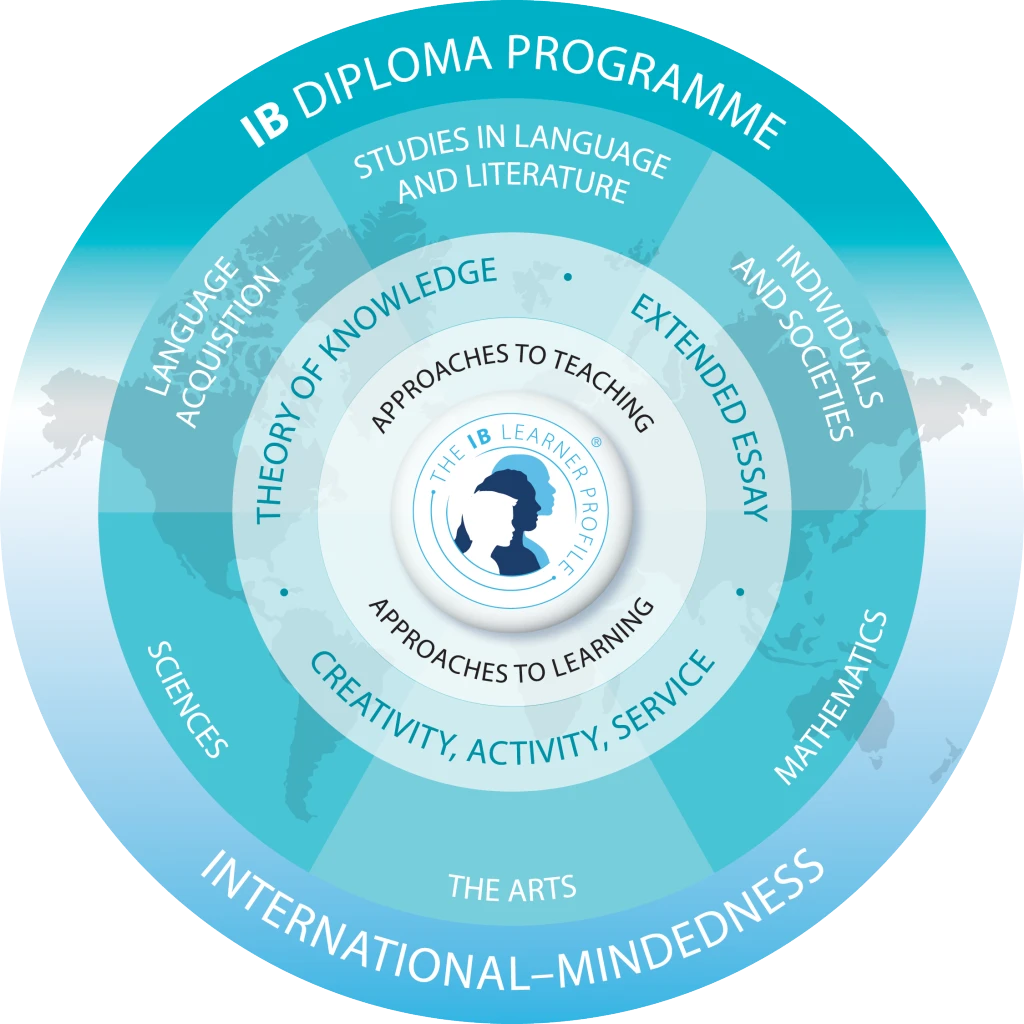
Three subject groups are mandatory for every student:
- Group 1: Language A (Studies in Language and Literature): typically the student's best language, English for most Indian IB schools
- Group 2 : Language Acquisition: an additional language, studied either as Language B (some prior background) or ab initio (from scratch). Alongside languages like Spanish, French, German, and Mandarin, the Indian languages offered are Hindi B, Hindi ab initio, and Tamil B
- Group 5 : Mathematics
The remaining three subjects are chosen from Groups 3 (Individuals and Societies), 4 (Sciences), and 6 (the Arts) with some genuine flexibility here, which we'll come back to.
Sitting at the centre of the DP are its three core components - Theory of Knowledge, the Extended Essay, and CAS along with the idea of international-mindedness. The IB places these at the heart of the diploma on purpose: they connect the six subjects rather than sit beside them.
Maths: AA or AI?
Group 5 splits into two different courses:
- Analysis and Approaches (AA): theory-driven, heavy on algebra, calculus, and proof
- Applications and Interpretations (AI): applied, heavy on statistics and modelling
Students aiming at engineering, physics, computer science, or any calculus-based degree should take AA, ideally at HL, since many university programmes expect it. AI suits students heading into business, design, or the social sciences. Treat this choice early and deliberately if an engineering or science path is even a possibility.
Switching HL and SL Later
Students can move a subject from SL to HL, or the reverse, after the DP has started. Schools allow this fairly often particularly when a student is clearly excelling at SL or, conversely, finding an HL subject unsustainable.
The important caveat is timing. HL subjects carry meaningfully more teaching hours and content than SL, so the realistic window for switching is early, generally by the end of the first year of the two-year programme (DP1), and ideally sooner rather than later. Leaving it until deep into the second year (DP2) makes catching up on missed HL content very difficult alongside internal assessments, the Extended Essay, and exam preparation all landing at once. Raise it with the teacher and DP coordinator as soon as the need is clear
Understanding Group Selection: Where the Real Flexibility Lies
Beyond the three mandatory groups, students choose their remaining three subjects from:
- Group 3 - Individuals and Societies: e.g., Economics, Business Management, History, Geography, Psychology
- Group 4 - Sciences: e.g., Biology, Chemistry, Physics, Environmental Systems and Societies, Computer Science
- Group 6 - The Arts: e.g., Visual Arts, Music, Theatre, Film
Here is the flexibility many parents don't initially realise: it is entirely possible and quite common for a student to skip Group 6 (the Arts) altogether and instead take a second subject from Group 3 or Group 4. A student with a strong science and commerce leaning, for instance, might take Chemistry and Physics as their two Group 4 subjects, or Business Management and Economics as two Group 3 subjects, rather than adding an Arts subject at all.
Choosing Subjects
Three things should drive the choice:
- Strengths: the student's academic record so far is the best guide to where HL will be comfortable.
- Interests: subjects like Psychology or Business Management are new to most students. Understand what they actually involve before choosing.
- Plans: some university courses need specific subjects or levels (Physics HL for engineering, for instance). Check target courses early.
A conversation with the school's IB coordinator or counsellor, ideally before subjects are finalised, is genuinely worth the time it takes.
The Indian Context: The BCP Question, ESS, and the "Non-Regular" Diploma
Many Indian students enter the IBDP wanting Biology, Chemistry, and Physics together, the familiar BCP combination for medicine. The problem: all three sit in Group 4. Normally, a student can take only one extra Group 4 subject beyond their main one, giving two sciences, not three.
It is possible to take all three sciences (Biology, Chemistry, and Physics), but only with the school's agreement and formal approval from the IB. If granted, and the student goes on to achieve 24 points or more, they are awarded what the IB calls a non-regular Diploma, rather than the standard Diploma. This is explicitly flagged as a deviation from the DP's underlying philosophy, which is built around breadth across the curriculum rather than early over-specialisation. Before requesting this provision, families are genuinely encouraged to reflect on whether it serves the student's needs, since narrowing the curriculum this early runs somewhat counter to what universities value about the IB profile in the first place and there is often a subject that can achieve the same goal without the exception.
That alternative is Environmental Systems and Societies (ESS). ESS counts as either a Group 3 or a Group 4 subject. A student can take Physics and Chemistry as their two sciences, then ESS as their Group 3 subject - three science-adjacent subjects on a completely standard diploma. A student leaning towards Biology could instead take Psychology (Group 3), ESS (counted as Group 4), and one more subject. Ask the DP coordinator about this before assuming BCP is the only route
The DP Core: What TOK, the Extended Essay, and CAS Actually Mean
For anyone encountering these terms for the first time, here's what each part of the Core actually involves and why the IB insists on all three.
Theory of Knowledge (TOK)
TOK is not a subject in the usual sense - there's no syllabus of facts to memorise. It's a course about how we know what we claim to know, examined across different areas: how do we establish knowledge in science versus history versus mathematics versus the arts? It's assessed through an exhibition (a short, personal exploration of how TOK ideas show up in real objects or situations around the student) and an essay. For a student used to subjects with clear right answers, TOK can initially feel unusual but it is often what students later describe as genuinely reshaping how they think, not just what they know.
The Extended Essay (EE)
The EE is an independent research essay, up to 4,000 words, on a topic the student largely picks themselves. It doesn't need to come from one of their six subjects. Done well, and aligned with a future degree, it can strengthen a university application.
Start early: aim to have a research question and early work done in the first year, with the essay mostly finished by the middle of Grade 12. Many marks reward the process, not just the final essay - a clear question, proper sources, accurate citations, and honest reflection. Students often lose marks by treating these as an afterthought.
Creativity, Activity, Service (CAS)
CAS is the part of the Core most easily misunderstood as "extracurriculars," when it's really something more deliberate. It asks every student to engage, over roughly 18 months, in genuine, sustained experiences across three distinct strands:
- Creativity: making or performing, not just consuming (music, writing, design, film)
- Activity: physical exertion that balances the academic load (sport, dance, fitness)
- Service: real engagement with a genuine community need
CAS is not formally graded and doesn't contribute to the 45-point score. But it is compulsory to be awarded the diploma at all, and it includes at least one CAS project - a sustained, collaborative undertaking lasting a minimum of a month, combining at least two of the three strands, with proper planning, action, and reflection throughout.
It's worth taking seriously precisely because it isn't scored. Universities read a well-documented, authentic CAS journey as evidence of a genuinely well-rounded, self-directed young person and for many students, it ends up being the most personally meaningful part of the whole DP experience. Grade 11 is a particularly good window to complete a substantial CAS project, since Grade 12 fills up quickly with exams and internal assessment deadlines. Treating CAS as something to "log" in the last few months rather than live through the whole two years is one of the most common and avoidable mistakes.
5. Assessment and Planning ahead
How Assessment Works
DP assessment has several parts:
- Written exams, sat in May of Grade 12, for most subjects
- A spoken and listening assessment for Language Acquisition subjects
- Internal Assessment (IA), a subject-specific task marked by the school and checked by the IB
- A portfolio or performance instead of an exam, for Group 6 Arts subjects
- TOK and EE, graded together for up to 3 extra points
Total: 42 points from six subjects, plus up to 3 from TOK/EE, for a maximum of 45. The pass mark is 24. Recent global averages sit just above 30, so 24 isn't a low bar, and anything short of near-perfect isn't a poor result eith
Building Good Habits Early
Most formal assessment falls in Grade 12, but Grade 11 effort is what makes Grade 12 manageable. Coursework, the EE, and CAS all build from day one. Habits worth building early:
- Reading ahead of class
- Finishing assignments on time, not in last-minute bursts
- Taking notes and actually reviewing them
- Acting on feedback quickly
- Reviewing material regularly, not just before exams
The DP also expects more independence: owning deadlines, asking for help early, and managing long projects like IAs and, for Visual Arts students, a time-consuming portfolio. Students who treat school deadlines as seriously as final ones tend to do well.
The Indian Lens: A Note on Engineering and Medicine
One thing Indian parents specifically should go into the IBDP with clear eyes about: the IB curriculum, however rigorous and well regarded internationally, is not built around the same syllabus as JEE (engineering entrance) or NEET (medical entrance), both of which are closely aligned with the CBSE/NCERT curriculum by design. IB students absolutely can, and regularly do, sit for JEE, NEET, and CUET- and plenty succeed but they typically need dedicated, additional preparation alongside their DP coursework to cover exam-specific content and question patterns that the IB syllabus doesn't map onto directly. IB Physics and Mathematics (particularly AA) do build strong analytical foundations that help with this preparation, but they are not a substitute for it.
If the goal is a government engineering or medical seat via JEE or NEET, plan for that as a separate, parallel track. If the goal is a global university or an international pathway, the DP's strengths - depth, research skills, recognition line up naturally. Neither curriculum is simply better; the right choice depends on the family's actual target, and the extra preparation IB students need for Indian entrance exams should be planned for from the start.
In Closing
Grades 11 and 12 are foundational in more ways than one, not just for the university door they open, but for the research skills, self-management, and critical thinking a student carries forward regardless of where they end up. The IBDP asks a lot of a 16-year-old, but it also gives a great deal back, provided the subject choices, the level decisions, and the day-to-day habits are built thoughtfully from the very start - not reactively, once Grade 12 is already underway.