What is Mandatory CBSE Disclosure?
A parent-friendly guide to what CBSE schools must publish and what to look for
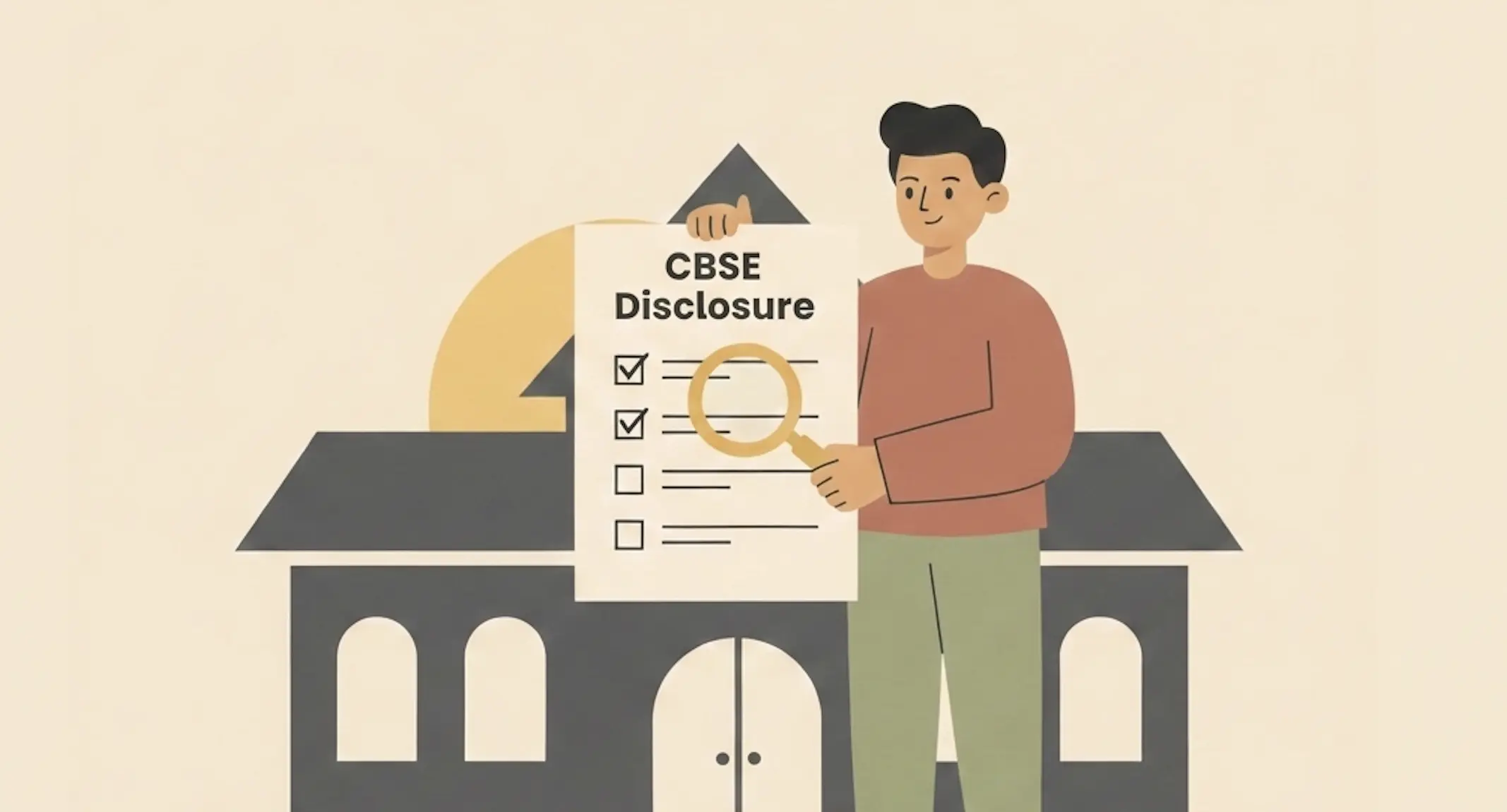
If you have ever researched schools in India, you have probably done this:
You shortlist 5 schools.
You open their websites.
And then… you fall into a black hole of glossy photos, “holistic learning” claims, and smiling children doing pottery.
But when you try to answer basic parent questions like:
- How many teachers are there?
- Is the building safe?
- Is the school even properly affiliated to CBSE?
- What’s their fee structure?
…you are left guessing.
That’s exactly what Mandatory CBSE Disclosure is supposed to fix.
It’s CBSE’s attempt to make schools publish a standard set of facts so that parents don’t have to rely only on marketing.
So let's dive in to know what it is:
What exactly is CBSE?
CBSE stands for the Central Board of Secondary Education which is one of India’s most common national school boards.
If a school is CBSE-affiliated, it means:
- It officially follows CBSE curriculum and academic standards.
- It must meet specified rules on infrastructure, staffing, safety, and governance.
- It is subject to periodic inspection and oversight by the board.
But just because a school’s website or brochure says “CBSE,” that doesn’t always mean it’s true or that it’s current.
There have been many instances where schools have claimed that they are affiliated to CBSE but aren’t. In 2023, over 700 Karnataka schools had received govt notice over false CBSE affiliation. In 2024, CBSE had filed legal complaints against Delhi schools that submitted fake documents to obtain affiliation. And as recently as Jan 2026, a mother filed a police complaint after discovering a Bengaluru school lacked valid CBSE affiliation even after taking admission fees.
This is where Mandatory CBSE Disclosure should help parents.
What is Mandatory CBSE Disclosure?
Mandatory CBSE Disclosure is a standardised set of information that every CBSE-affiliated school in India is required to publish publicly — usually on its official website. (link - https://saras.cbse.gov.in/SARAS/Circulars//OSAMS_Circular/09%20circular.pdf)
The idea is simple:
If you’re going to call yourself a CBSE school, you must publish basic facts so that parents can see the reality.
What information should a Mandatory CBSE Disclosure page include?
While formats vary slightly from school to school, CBSE generally requires these key categories in public disclosure:
1) Basic School Information
This includes:
- School name and address
- CBSE affiliation number
- School code and contact details
- Principal’s name and year of establishment
2) Affiliation and Recognition Details
This section typically shows:
- The actual CBSE affiliation certificate
- Whether the affiliation is provisional or permanent
- Validity dates and grades approved
This is crucial because sometimes schools only have affiliation up to a certain grade or their validity may have lapsed without renewal.
3) Safety and Compliance Certificates
- Fire safety certificate
- Building safety certificate
- Water and sanitation certificate
- State government NOC (No Objection Certificate)
- Recognition certificate (state board approval)
4) Teacher and Staff Information
- Total teachers
- Qualifications
- Trained teachers
- Teacher-student ratios
- Counsellors or special educators
5) Infrastructure Details
- Total campus and built-up area
- Number of classrooms
- Science/computer labs
- Library and sports facilities
- Toilets and sanitation access
6) Fee Structure and Academic Details
- Fee breakup
- Academic calendar
- PTA/SMC details
So what should parents actually do?
1) Look for the disclosure page early
Before you fall for glossy photos and videos. If you can’t find it on the school’s official website, ask for it.
2) Verify the affiliation number yourself
Cross-check the affiliation number on the CBSE website (link: https://saras.cbse.gov.in/saras/AffiliatedList/ListOfSchdirReport) or ask the school to show the certificate before paying anything.
3) Check safety certificates and NOC
Pay attention to dates, older than one or two years may mean they haven’t updated. If you don’t understand a certificate, ask for clarification during your visit.
4) Note teacher counts and ratios
Even rough numbers help you understand staffing load.
5) Use it as basis for conversation during your visit
Instead of questions like “Is your school safe?”, you can ask: “I saw the fire safety certificate was last renewed in 2022 - can you show me the current one?”
So, the next time you shortlist a school, do look for Mandatory Disclosure tab in the school website. And, if you find it is not there, consider it as a red flag and ask for details when you visit the school.
If you are comparing a few schools right now, it also helps to hear from parents who have already been through the same decision. That’s exactly what HaloParent is for. Do check the conversations on Haloparent. Also, if you found this article useful, do share it with other fellow parents.